
Economic and National Security: From Awareness to Action
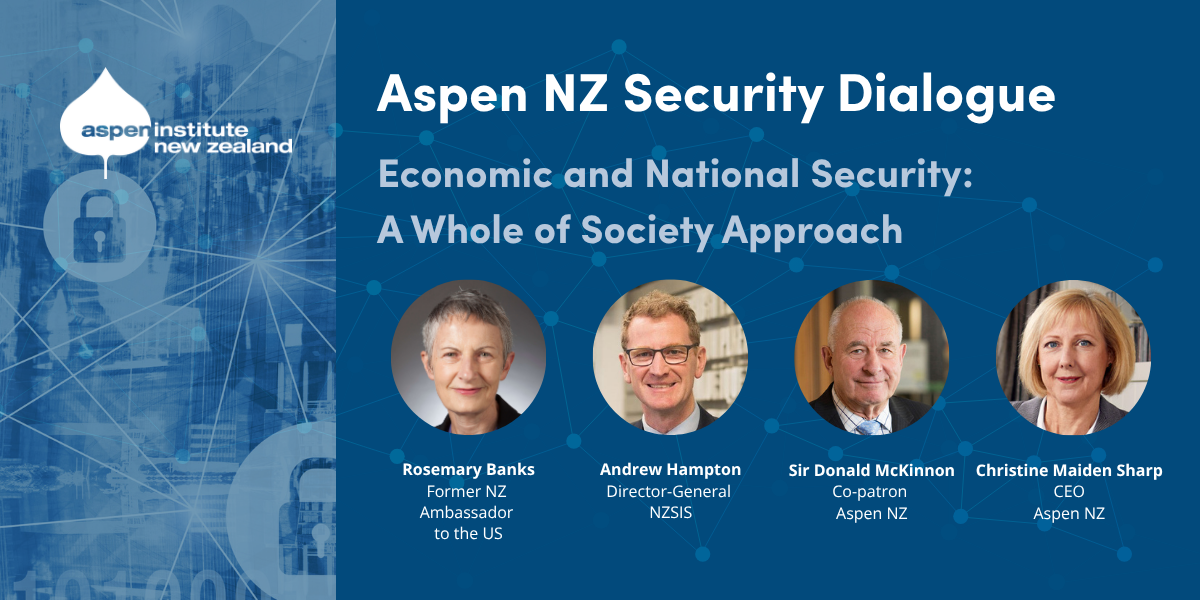
Senior leaders from business and government joined the Aspen Institute New Zealand’s Security Dialogue last week, continuing the conversation on economic and national security. Originally planned as a roundtable in Wellington, severe weather forced a last-minute shift online, which was a fitting illustration of the adaptability the session itself would go on to examine. Where February’s Auckland Security Dialogue focused on making sense of a changing global environment and what it means for business and government, Wellington shifted the conversation toward what that change requires in practice. The emphasis moved from understanding the challenge to responding to it. As Aspen NZ co-patron Sir Donald McKinnon observed:
“There has never been a time when national security has required such sustained attention.”
A System in Transition
Rosemary Banks, former New Zealand Ambassador to the United States, described the current environment as the most challenging in decades. The international order that gave countries like New Zealand a degree of predictability is eroding, and what will remain of it is unclear. Raw power and strategic competition are displacing rules and shared norms. Banks noted that this is not a temporary disruption. The adjustment is structural, playing out simultaneously across security, economic, and technological domains. For small, open economies like New Zealand, the implications will unfold over years, not months.
New Zealand”s reliance on global trade, international partnerships, and open institutions presents risks and exposure. But there may also be opportunities to position our country even more closely with those of our Indo-Pacific neighbours who broadly share the same world view and values.
"As changes in New Zealand's geostrategic environment accelerate, it is time for a wider national debate on the different dimensions of national security. We should be realistic but not fatalistic about the risks we face as an open and trade dependent society, while we continue to thicken our network of trusted trade, economic and security relationships."
Rosemary Banks, Former New Zealand Ambassador to the United States
Navigating a More Complex Strategic Environment
A recurring theme was New Zealand’s position between two relationships that are pulling in different directions. The country depends on the United States for security and intelligence cooperation and as its second largest trading partner, while China remains its largest, accounting for nearly double the trade value of the United States. As tensions between those two powers increase, managing both relationships has become considerably more difficult.
The United States remains central to New Zealand’s security architecture, particularly through intelligence partnerships. At the same time, a more inward focused US foreign policy has introduced new uncertainty, widening the gap between public perception and the official narrative .
Regional relationships are also assuming greater importance. Australia’s growing influence in the Pacific was discussed, alongside the opportunity for New Zealand to deepen engagement across the Indo-Pacific. The appetite for a more active regional role exists, but participants noted it needs to be matched by capability and investment.
The Evolving Threat Environment
NZSIS Director-General Andrew Hampton described the current threat landscape as the most complex New Zealand has faced in decades, shaped by three converging pressures: intensifying geopolitical competition, rising social polarisation, and rapid technological change.
Foreign interference and espionage remain persistent. Activity is typically directed at accessing sensitive information, influencing communities, or exploiting economic and political relationships. Artificial intelligence and other digital technologies are lowering the barriers to these activities and extending their reach.
Government agencies, businesses, and research organisations are all potential targets. Overseas engagement, including routine business travel, presents additional risks. No single actor or ideology defines the threat environment, but a range of state and non-state actors remain active, some with considerable persistence and sophistication.
From Principle to Practice
If Auckland established the case for treating security as a collective responsibility, Wellington examined what that looks like in practice. For business leaders in the room, security is no longer a peripheral concern or a compliance obligation, it now surfaces in decisions about partnerships, data, supply chains, and market entry. The discussion emphasised that organisations need to treat security as a core part of how they operate. Hampton noted a growing recognition that national security and future prosperity are increasingly connected, a realisation that is beginning to shift how organisations think about risk.
"What we need now is to see more security conversations move from the back office to the board table." Andrew Hampton, Director-General, NZSIS
Encouragingly, many risks are manageable. Sound cybersecurity practices and basic organisational awareness can address a significant proportion of threats. The challenge is maintaining consistency, ensuring fundamental protections are in place and that accountability for security is understood at every level of an organisation, not just the top.
There is also an opportunity for closer collaboration between government and business, particularly on information sharing and the development of minimum standards. Resilience at a national level is a collective effort, requiring coordination and trust across sectors.
Operating Within Constraints
New Zealand cannot control the forces reshaping the global environment, and the discussion did not shy away from that reality. The task is to navigate them with greater awareness and preparation, making considered trade-offs, including balancing economic openness with security, maintaining relationships without over-dependence, and responding to external pressure without escalation. This type of judgement, applied consistently across sectors, is what the current environment asks of leaders.
"We will become more resilient as a country when leaders across all sectors have a clear-eyed understanding of the threats New Zealand faces and holistic plans in place for how they will protect their most critical assets." Andrew Hampton, Director-General, NZSIS
A More Exposed Future
The period ahead is likely to bring overlapping pressures, and New Zealand is more exposed to them than it was a decade ago. Awareness of that reality has not yet caught up across all parts of society and the economy, and there is work to do across government, business, and communities to close that gap. What emerged from the discussion was a sharper sense of the right questions, and a recognition that working through them together is how the response takes shape.
The Wellington Security Dialogue is part of Aspen Institute New Zealand's ongoing Security Programme.
Sector-focused roundtables planned for later in 2026 will bring together industry leaders to examine how geopolitical change and security pressures are reshaping their sectors, and how they might respond. If you are interested in attending or getting involved, please contact us.