
Economic and National Security: A Whole-of-Society Approach
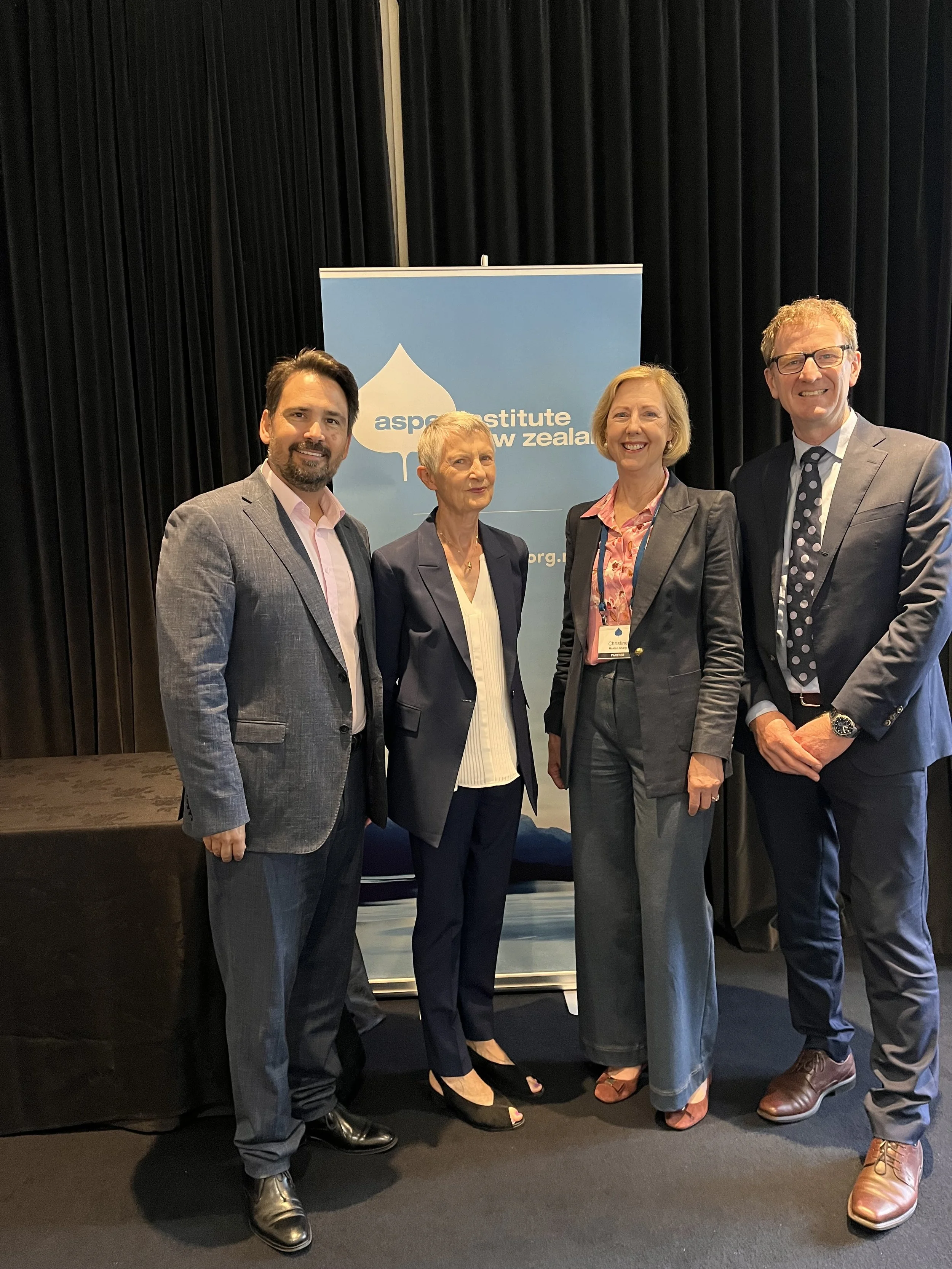
Auckland hosted senior leaders from across business, government, and civil society this week for the Aspen Institute New Zealand’s Security Dialogue on Economic and National Security. Held under the Chatham House Rule at The Northern Club, the private roundtable marked the beginning of Aspen NZ’s 2026 focus on New Zealand’s Place in the World 2050.
The discussion took place against a backdrop of increasing geopolitical fragmentation and a gradual erosion of the rules-based order that has underpinned New Zealand’s prosperity for decades. Participants reflected on a shift from a system shaped largely by agreed norms toward one more openly influenced by power, strategic competition, and technological rivalry. In that environment, economic resilience and national security are no longer parallel considerations; they are deeply intertwined.
The International Context
Former New Zealand Ambassador to the United States Rosemary Banks outlined the changing character of the international system and the implications for countries such as New Zealand. She described an environment in which traditional assumptions about stability and leadership can no longer be taken for granted, and where global influence is increasingly fragmented across security, economic, and technological domains.
“Our concept of security is evolving as New Zealand’s geostrategic environment grows more hostile to our interests. We are coming to terms with the end of an extended period of stability and with the disruptive impacts of technological, climate and social change. Aspen Institute NZ is bringing us together for informed discussion of how to stay resilient.”
For New Zealand, this raises practical questions. The country remains heavily reliant on the United States for both trade and security cooperation, even as US foreign policy priorities evolve. At the same time, relationships within the Indo-Pacific, particularly with Australia and regional partners, are assuming greater importance. Participants discussed the need to balance long-standing partnerships with diversification, recognising that missteps in this environment carry greater consequences than in the past.
The Current Threat Environment
Director-General of the New Zealand Security Intelligence Service, Andrew Hampton, provided an overview of the evolving threat landscape. Drawing on recent public reporting, he noted that New Zealand is operating in its most complex security environment in decades, shaped by foreign interference, espionage, malicious cyber activity, and a persistent violent extremist threat.
Foreign interference remains a significant concern, with efforts often directed at accessing sensitive information, influencing communities, or exploiting economic and political uncertainty. At the same time, New Zealand’s advanced research capability, globally connected businesses, and open economy create both opportunity and exposure. Cyber vulnerabilities within supply chains, insider risks, and the targeting of intellectual property were discussed as practical challenges facing organisations of all sizes.
Hampton emphasised that while intelligence partnerships such as Five Eyes continue to function, New Zealand cannot fully insulate itself from global pressures. The challenge, he noted, is to raise awareness of threats without creating alarm, equipping institutions and businesses to recognise and manage risk while remaining outward-looking and engaged.
Whole-of-Society: From Principle to Practice
A consistent theme throughout the roundtable was the need for a “whole-of-society” approach to national security. Participants explored what this means in practical terms for business leaders and boards, particularly as security considerations become embedded in everyday decisions about partnerships, data management, supply chains, and international engagement.
Several business leaders observed that security issues, from cyber resilience to economic coercion, now surface routinely within corporate strategy discussions. For some, this represents a shift from viewing security as a compliance obligation to recognising its role in sustainable growth. As Aaron Bhatnagar noted, “Security is an enabler of prosperity”. Organisations that build security awareness into governance and operations may be better positioned to manage volatility and maintain trust.
At the same time, questions were raised about coordination across sectors, particularly for smaller and medium-sized enterprises that may lack the scale or resources to invest heavily in risk management. The discussion underscored both the opportunity and the responsibility for closer collaboration between government and the private sector.
Questions for the Year Ahead
The Dialogue did not seek to resolve every tension. Instead, it surfaced a set of enduring questions: how much reliance on any single trading partner is prudent in a fragmenting world; how New Zealand should balance openness with protection; and what resilience looks like in practical, operational terms.
What was clear, however, was that security and prosperity can no longer be treated as separate domains. Business leaders are not bystanders in this environment, nor are government agencies all-seeing. There was a strong willingness among those present to engage seriously with these challenges, recognising that leadership now carries responsibilities that extend beyond commercial performance alone. Sustaining New Zealand’s standard of living and global engagement will require informed judgement, partnership, and steady leadership across sectors.
This Dialogue forms the first in a series of Aspen NZ discussions examining how economic strength, national security, and global positioning intersect as New Zealand considers its place in the world to 2050.