
Insights from Global Changemakers 2026
Decision Making in an Age of AI
By Alexander Plimmer, Aspen NZ Global Changemakers Scholarship Recipient 2026
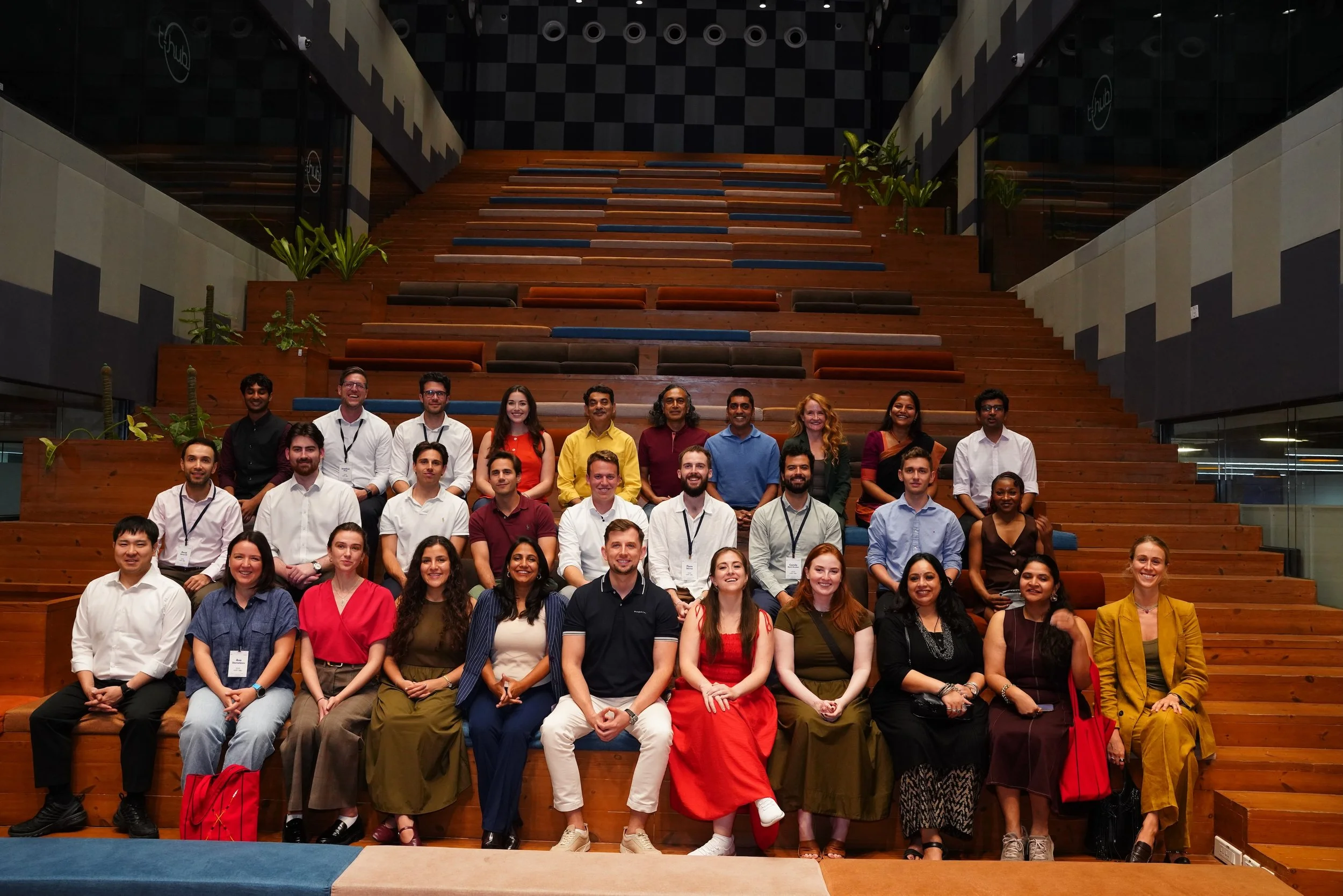
In September, I had the privilege of attending the Aspen Institute International Partners’ Global Changemakers Workshop in Hyderabad, India. Across a rewarding four days, 20 emerging leaders from 16 countries engaged in different workshop formats to consider one of the defining questions of our time: how will artificial intelligence change the way we make decisions, and which decisions should remain human?
I arrived eager to better understand the development of AI, the structures forming around it, and how these technologies might ultimately be utilized. In my professional experience I had already seen the usefulness of AI as a tool for productivity and enhancing human capacity, but was equally conscious of the questions it raises around human agency. What became increasingly clear throughout the workshop, however, was that the challenge is not simply understanding what AI can do; it is understanding how we choose to use it, who benefits from it, and who bears the consequences when it does not work as intended.
The workshop began with a series of text-based seminars and policy roundtables that explored AI from a number of different perspectives. We considered AI as a new infrastructure of power, its implications for institutions, work and access, its growing role in national security and strategic competition, and the governance and guardrails necessary to manage it. Rather than treating AI as a purely technological development, these discussions placed it within the wider systems of society, economics, politics and power.
One of the most striking themes that I had not previously considered was the uneven distribution of both the opportunities and risks created by AI. As these systems become increasingly integrated into education, employment, government and other aspects of everyday life, the effects will extend far beyond those directly involved in developing them. It became apparent that the data used to build these systems, and on which models are trained, are not necessarily representative of everyone who will be affected by the decisions. Those already most vulnerable may consequently face some of the greatest risks.
This created a tension that followed us throughout the workshop. AI is often presented as a technology capable of improving lives, increasing productivity and solving problems that have previously been difficult to address. Yet these benefits are not inevitable. Without careful consideration of access, representation and accountability, technologies designed to create greater efficiency could also reinforce existing inequalities. The question therefore becomes not simply whether AI makes decisions better, but better for whom?






One comment made by a moderator during the workshop stayed with me in particular: leadership requires real sacrifice, and you cannot delegate sacrifice. We were also reminded that the decisions made today will influence tomorrow. These comments became increasingly relevant to how I thought about the challenge of AI. There is an understandable temptation to see increasingly capable AI systems as a means of delegating difficult decisions. If a system can process more information, identify patterns faster, and make increasingly accurate predictions, it is natural to ask whether it should also play a greater role in determining what we do. However, the ability to delegate a decision does not necessarily mean that we can delegate responsibility for its consequences.
This is perhaps where the question of AI becomes fundamentally a question of leadership, with the very workshop put together by the Aspen Institute serving as evidence of the increasing importance of that connection. The decisions being made today about how these technologies are developed, regulated and deployed will shape the society in which we live tomorrow. Choosing to rely on AI is itself a decision, as is choosing where it should be used, who should have access to it, and what safeguards should govern its use. AI may increasingly inform our decisions, but the responsibility for deciding what kind of future we want cannot simply be handed over to the technology itself.
Being in India added another important dimension to these discussions. Through visits to Micron Technology and T-Hub, Hyderabad provided an invaluable opportunity to see the development and application of technology firsthand. Witnessing practitioners, entrepreneurs and industry leaders working within a rapidly developing technology ecosystem made many of the discussions feel considerably less abstract. It was a reminder that these questions are not distant or hypothetical. Decisions about AI are already being made, technologies are already being deployed, and the effects are already being experienced.
The Global Changemakers Workshop also reinforced the value of approaching these questions from different perspectives. Bringing together participants from different countries, sectors and professional backgrounds meant that the same development could be viewed through very different lenses, something incredibly powerful in a world where AI systems will operate across borders. Representing New Zealand while also bringing a perspective and understanding grounded in my time at Columbia University in New York City, allowed me to contribute to the discussions in thoughtful and alternative ways.
As always, I am incredibly grateful for the opportunity given by the Aspen Institute New Zealand and the broader Aspen network to participate in such thoughtful and challenging discourse. Beyond the formal discussions, the experience of learning alongside an exceptional group of people from around the world was a reminder of the value of open dialogue and international exchange. I leave the workshop not with definitive answers to the questions AI presents, but with a greater appreciation of the responsibility we have in shaping the answers.